3 Ways AI Will Impact Game Accessibility
Explore the 3 most significant ways AI will be used to make games more accessible to all players.
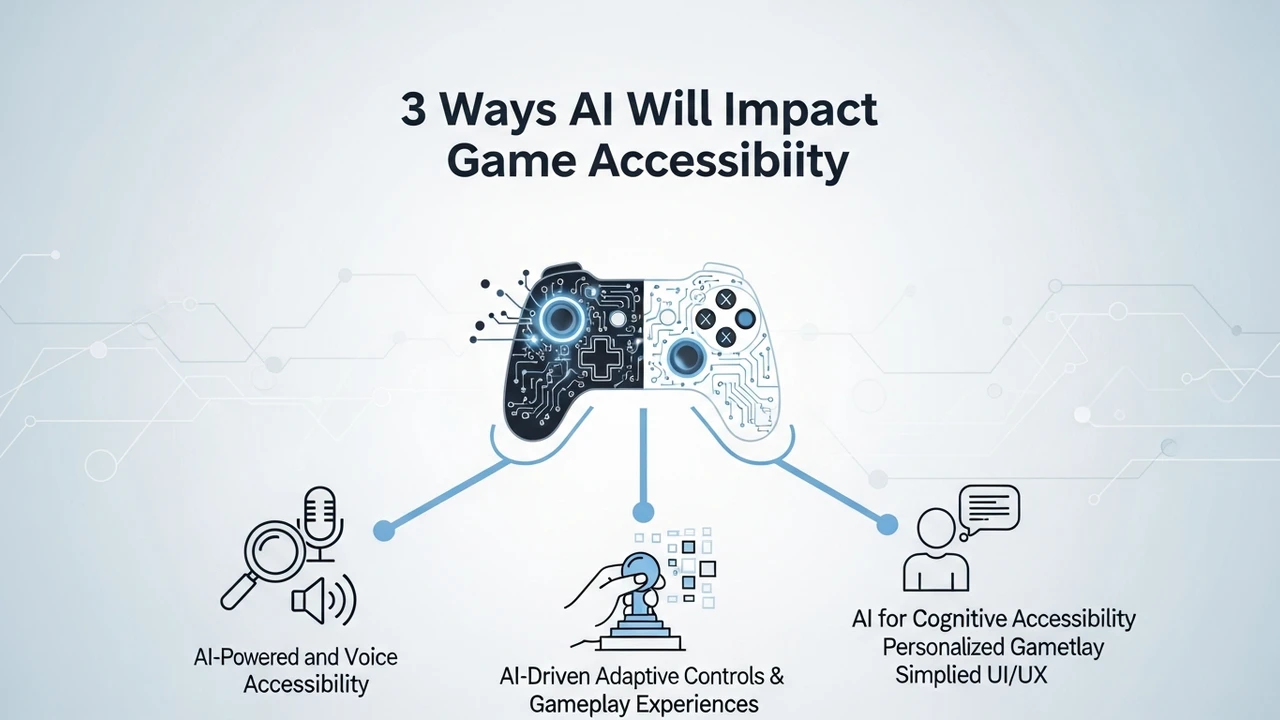
3 Ways AI Will Impact Game Accessibility
Explore the 3 most significant ways AI will be used to make games more accessible to all players.
Gaming is for everyone, but for a long time, that hasn't really been the case. If you have a motor impairment, visual loss, or hearing difficulties, jumping into a AAA title often feels like hitting a brick wall. But things are changing fast. Artificial Intelligence is stepping in as the great equalizer, breaking down barriers that used to keep millions of players on the sidelines. We are moving toward a future where the game adapts to the player, not the other way around.
AI Driven Adaptive Controls and Input Mapping
One of the biggest hurdles for gamers with physical disabilities is the standard controller layout. AI is now being used to create adaptive control schemes that learn how a player moves and adjusts inputs accordingly. Instead of forcing a player to master a complex "claw" grip, AI-driven software can remap buttons in real-time based on the player's physical capabilities. Tools like the Xbox Adaptive Controller have paved the way, but AI takes it a step further by predicting intent. If a player struggles with a specific sequence, the AI can simplify the input requirements without ruining the challenge of the game. For example, software like AbleGamers' custom mapping tools and Microsoft's Adaptive Accessories are already utilizing machine learning to interpret non-standard inputs, making high-octane action games playable for those with limited mobility.
Real Time Audio and Visual Assistance via AI
For players with visual or hearing impairments, the game world can be a confusing place. AI is changing this by providing real-time sensory translation. We are seeing the rise of AI-powered audio description tools that narrate what is happening on screen, from enemy movements to environmental cues. On the flip side, for the hearing impaired, AI can generate dynamic, context-aware subtitles that don't just transcribe dialogue but also describe the emotional tone of a sound effect or the direction of a threat. Google’s Live Caption technology is being integrated into more gaming environments, and specialized tools like Seeing AI are being adapted for gaming contexts. These tools are essential for creating a level playing field where a player with low vision can navigate a 3D space just as effectively as a sighted player.
Personalized Difficulty Scaling and Cognitive Support
Not every accessibility challenge is physical. Many players struggle with cognitive load, processing speed, or neurodivergent conditions that make fast-paced games overwhelming. AI is now being used to create "dynamic difficulty adjustment" that is far more sophisticated than just changing a health bar. It monitors how a player interacts with the game and subtly adjusts the pace, the amount of information on screen, and the complexity of puzzles. Products like Adaptive Difficulty Engines found in modern engines like Unity and Unreal are allowing developers to bake these features directly into the game code. When you compare these to older, static difficulty settings, the difference is night and day. You aren't just choosing 'Easy' or 'Hard'; the game is learning your specific needs and providing a tailored experience that keeps you in the 'flow state' without the frustration.
Product Comparison and Market Insights
When looking at the current market, there are a few key players leading the charge. Microsoft’s Adaptive Controller (approx. $99) remains the gold standard for hardware-level accessibility, offering massive customization. On the software side, SpecialEffect’s EyeMine (free) is a game-changer for eye-tracking, allowing players to control Minecraft with just their eyes. If you are a developer, integrating Unity’s Accessibility Plugin (free) is a no-brainer for implementing basic screen reader support. The cost of these tools varies, but the trend is clearly moving toward open-source and integrated solutions, meaning accessibility is becoming a standard feature rather than a luxury add-on. Whether you are a casual player or a hardcore enthusiast, these AI-driven advancements mean that the barrier to entry is lower than it has ever been, and the gaming community is finally becoming the inclusive space it was always meant to be.
:max_bytes(150000):strip_icc()/277019-baked-pork-chops-with-cream-of-mushroom-soup-DDMFS-beauty-4x3-BG-7505-5762b731cf30447d9cbbbbbf387beafa.jpg)